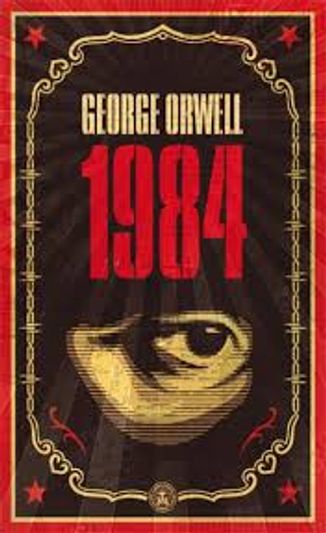
English Assignment on George Orwell's Book 1984 - Jack LaBrash
English Assignment on George Orwell's Book 1984 - Jack LaBrash
English Assignment on George Orwell's Book 1984 - Jack LaBrash
English Assignment on George Orwell's Book 1984 - Jack LaBrash
English Assignment on George Orwell's Book 1984 - Jack LaBrash
English Assignment on George Orwell's Book 1984 - Jack LaBrash
Preface
Dear Reader,
The project you are about to read has a multi media context, showcasing different forms of media to present my thesis.
The first genre of media I have chosen to do is a formal essay. In this essay I will demonstrate how using one limited viewpoint shows Orwell's theory of political control in the book. It will further consider how lacking the viewpoints of other people helps the status quo and changes the narrative effect.
The next genre of media will be a podcast episode. In this podcast episode I will be interviewing the singing prole woman that acted as a symbol of hope to Winston while he used his rented room above Mr. Charrington’s shop. She is never named or says anything other than her singing, but as a prole woman she would live outside the Party’s control. Hearing her voice could shed a different perspective and could provide a true reflection of how the proles think.
The last genre of media will be a letter. This letter will be written to Goldstein, although there is no proof that he exists Winston believes he would represent truth and the resistance to the Party. Clarifying Goldstein’s perspective would confirm Winston’s beliefs.
These three genres bring together the overarching idea of perspective. Perspective not only plays an integral part in Orwell's book 1984, but it has also been valuable in my understanding and interpreting of his message.
Thank you and Enjoy,
Jack LaBrash
Repetend
“If you want to keep a secret, you must also hide it from yourself.”
Multi-Media Essay
Orwell uses primarily a single narrator's perspective of Winston throughout the book 1984. He makes his readers understand that silencing different opinions helps the authoritative power exist as no one can hear the voices of others such as women and children. New voices of the characters would potentially disrupt the power of the Party and lead to resistance change and freedom in the novel. By holding the reader to the inner world of Winston and his beliefs and perceptions, Orwell demonstrates a very narrow point of view and one that does not agree with the current reality and status quo. The lack of other voices, including those of the marginalized groups, highlights bigger implications of totalitarian rule and the importance of enforcing power by preventing others from speaking out.
The perspective of Winston dominates the novel and the readers see the Party as negative and manipulative of most people’s minds Nonetheless, this view point though revolutionary has his eyes narrowed down to his personal dissatisfaction. He has questions and hopes for intellectual freedom and he is fixated on the need for a different truth and he believes others share this belief as well but choose to hide it and live in misery. The absence of the women and children’s voices leads to the thinking that these voices are not valued or they are simply under the control of the Party. An example of this is the character of Julia who the reader feels is an important character in the book. There is a focus on how she affects and feels for Winston but very little is explored about her personality, her history or how she truly feels about the status quo. The reader never really knows Julia’s motives or backstory which alludes to the idea that her personal opinions and experiences, just like every other woman, are not important, valued or relevant in the story.
The fact that children are not referred to much in the book at all creates the notion that family and human connection are not acknowledged and that having feelings, emotions and attachments to other humans does not have a part in the Party’s agenda. Children are described as instruments of the regime that relay information to the authorities even if it is about their parents committing crimes against the Party. Orwell does this to demonstrate the extent of the system's control and even the most innocent individuals become the sources of fear, breaking down human instincts. If a child's voice or character was more prominent in the book there would be a risk that a reader would sympathize with the child’s actions further seeing the horror of the Party and its total need for control. It is easier for the reader to potentially accept that children are simply brainwashed and don’t know any difference therefore accept the authoritarian mandate.
Winston’s singular perspective of skepticism toward the Party along with feeling the intensity of the surveillance and continual opposition to his thoughts by things like the telescreens and co-workers, the reader is forced to question his state of mind throughout the book. This further aids in securing Party rule and the status quo.
Orwell imitates the Party approach of interfering with anything that makes one unwilling to shut down opposing voices as well as diversity of opinion. This stylistic choice shows that the lack of a perspective is a literary and political device. Then again, the possible addition of other characters' perspectives such as those of women or children would only threaten the Party dominion over the story presented. These voices may mention other kinds of resistance, like emotional perseverance, family feelings, or community memory zones which Winston himself cannot appreciate or make known to us.
To sum up, the fact that Orwell decided to tell the story 1984 from primarily Winston's viewpoint, encourages the reader to believe that the power of the Party is the status quo.
Missing perspectives allow for less resistance toward the regime. Orwell creates a situation of power and control that could never be questioned with consequence. As the reader you are subjected to the experience of oppression and the loss of individualism. You begin to feel that harsh reality of brainwashing and manipulation that ultimately leads to a totalitarian society. Orwell wanted to be very strategic in presenting the dangers in this.
Repetend
“The birds sang, the proles sang. The Party did not sing. All around the world, in London and New York, in Africa and Brazil, and in the mysterious, forbidden lands beyond the frontiers, in the streets of Paris and Berlin, in the villages of the endless Russian plain, in the bazaars of China and Japan—everywhere stood the same solid unconquerable figure, the same shape of a woman going up and down with a bucket between her swaying hips, and singing.”
Podcast
Jack Jones Podcast Interview with Singing Beauty from the Backyard
Repetend
“If there is hope, it lies in the proles.”
Dear Goldstein Letter
Dear Goldstein,
My reasons for writing this letter are that I do not know whether you live or not; but I must believe that you do. In the world where the Party bases its power on control over thought, word and memory, the concept of you is the final glimmer of truth.
They brand you as a traitor, the people hater. I do not hate you but I admire you. The sentences in your book provided me with the clarity that I did not expect to get again. You have quite literally spoken language which I have long suspected but could never put into words: the Party maintains its power by removing the truth and bottling reality.
I am still comforted by the thought that at some time, someone was different, at some time someone stood up. Your thoughts bring to mind that I am not crazy, that two plus two actually is four.
I am not with the many and I am not sure that I am the only one who thinks this. And there are others, few, indistinguishable: with the same quiet rebellion in their hearts. We understand our resistance through your voice and your voice is not real or not.
I do jot expect any reply. I might not live to the point of finding out the truth. I needed to write this however to reaffirm that I am still remembering, still doubting, and still believing.
In silent defiance,
Winston Smith
Repetend
“He was the primal traitor, the earliest defiler of the Party’s purity. All subsequent crimes against the Party, all treacheries, acts of sabotage, heresies, deviations, sprang directly out of his teaching.”
Conclusion
Wrapping things up through these three pieces of media I have highlighted how Orwell's use of perspective and storytelling through the mind of Winston silences various opinions and voices. In the book not hearing these alternative voices and perspectives is what allows political control to exist. After diving deeper into that with my formal essay, I then used the opportunity to gather an understanding of what it would be like to hear from some of these other voices and perspectives with my podcast episode and written letter.
Copyright © 2025 Jon LaBrash - All Rights Reserved.
REALTOR®, REALTORS®, and the REALTOR® logo are certification marks that are owned by REALTOR® Canada Inc. and licensed exclusively to The Canadian Real Estate Association (CREA). These certification marks identify real estate professionals who are members of CREA and who must abide by CREA's By-Laws, Rules and the REALTOR® Code. The MLS® trademark and the MLS® logo are owned by CREA and identify the quality of services provided by real estate professionals who are members of CREA.
The trademarks MLS®, Multiple Listing Service®, and the associated logos identify professional services rendered by REALTOR® members of CREA to effect the purchase, sale and lease of real estate as part of a cooperative selling system.
Cookie Policy
This website uses cookies. By continuing to use this site, you accept our use of cookies.